
Why does heartbreak hurt like a broken arm?
Mayer, Mystery, and Mayhem
Inthe aftermath of the most ‘gut-wrenching’ break up of my life; I hopped my way in and out of despair. And initially, I did what I thought level-headed people do: I exhausted myself with work. I would study for over 12 hours a day, and sleep only when my lids were droopy with denial. When there was no way left to oppose the truth, I came to the painful realization that I was feeling utterly rejected. As a consequence, I dived headlong into anything that kept me distracted. I rummaged through movies, songs and literature, and always settled on the melancholic lot. One afternoon, as a bona fide addition to my break-up playlist, John Mayer blared through my earphones.
“Drop his name
Push it in and twist the knife again
Watch my face
As I pretend to feel no pain, pain, pain”
–Heartbreak Warfare, John Mayer
In the rest of this article, I will take many meticulous measures to sound thoroughly analytic. Therefore at this point, it would be fair to add that despite all, I milked my sorrow dry for all its worth. In the loopy ride of dozen such songs, I suddenly began growing curious. I realized that like John Mayer, I keep equating emotional pain to physical pain. I do it in whimpers and metaphors, similes and allusions. And as it turned out, Mayer and I were not the only ones to do so. Now the next critical question was: Do we only do it for literary fineness or was there something more to it? Or was my grieving brain stitching two corner pieces of a puzzle together? Therefore, I went back to the playlists, watch-lists, and bookmarked pages. And I looked for what would become the children of an otherwise fruitless breakup.
“The heart dies a slow death, shedding each hope like leaves until one day there are none.”- Arthur Golden, Memoirs of Geisha
“It’s like pieces of glass in my head all the time. Can you understand?”- John Coffey (Michael Clarke Duncan) in The Green Mile (1999)
Within the first three hours on the internet, I found out that I was neither the first nor the only person asking these questions. A psychologist, Naomi Eisenberger was also wondering if there were any connections between the brain’s perceptions of a broken arm as opposed to a broken heart. I can only presume that unlike mine, her curiosity was not driven by whimpering young love. In her landmark experiments, now famously called the Cyberball studies in 2003, Eisenberger tested the impact of social rejection on the brain. Participants were strapped with virtual-reality headsets. They could see their own hand and a ball, plus two cartoon characters — the avatars of fellow participants in another room. With the press of a button, each player could toss the ball to another player while the researchers measured their brain activity through fMRI (functional Magnetic Resonance Imaging) scans. In the first round, everything seemed to be normal. But as the game progressed, the two other players stopped passing the ball to the participant. In reality, there were no other players: just a computer programmed to ‘reject’ each participant so that the scientists could see how exclusion -what they called ‘social pain’ — affects the brain.
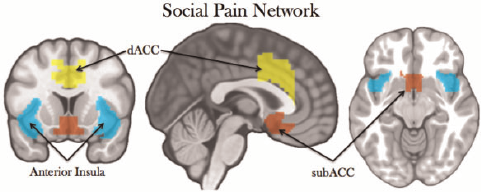
Let us analyze an unfortunate but largely common experience across cultures- tumbling down and scathing a knee as a child. As a result of such an injury, a number of brain regions get activated. Some regions are imperative in detecting the location of the injury. And others aid in experiencing the subjective unpleasantness of an injured knee- the emotional component of physical pain. Therefore, when you were deafened by your squeaky sneakers and did not pay attention to the pumpkin sized crater and fell, a few things happened. Firstly, the nociceptors (pain receptors) made a quick call to your brain to feed the location of injury. Secondly, the Anterior Insula (AI) and dorsal Anterior Cingulate Cortex (dACC) got activated, which bear the brunt of relaying the emotional underpinnings of the great fall. In other words, they helped your brain process that you are hurting, and that there is pain involved. Now let us go back to Eisenberger’s study. She found that the participants’ AI and dACC were activated when the ball stopped getting passed on to them. In fact, the stronger the participants’ self reported social pain, the greater the brain activity. In short, a rather revolutionary implication came to the fore. Metaphorical employment or not, it is possible that the brain does not anatomically differentiate between social pain and physical pain. To it, unlike human assessment, a broken heart could be as painful as a broken arm. Does that mean that social rejection has to be explicit, like in Eisenberger’s study? Research says not necessarily. Kross’ study (2011) proposes that unexpectedly coming across a picture of a former romantic partner may activate the same response. Whereas, Burklund (2007) suggests that watching a video of disapproving faces of strangers also has the same effect.
With its efficient neuronal networks and the largest mammalian cerebral cortex, how could the human brain not distinguish between physical pain and social pain? Eisenberger turns to ‘evolution’ to find answers. To protect themselves from physical danger, our ancestors survived in packs. As civilizations developed, we also began shaping our identities in relation to other people, and not merely coexisting. With time, these communities protected the individual human being from both physical harm and social isolation. Therefore, according to Eisenberger, the brain may have simply ‘borrowed’ the mechanism that is used to detect and evaluate physical pain instead of creating one for social pain.
What happens when the alarm goes rogue?
Kawamoto and his colleagues (2017) equate this social pain to an alarm system. They state that we detect, appraise, and attempt to regulate this alarm in many ways. In this equation, detection and appraisal of the rejection are signals which indicate that there is a problem. The appraisal system acts like an intelligent but panic-driven gatekeeper which assesses the severity of the rejection. It then sets off the infamous warning sound, based on the said assessment. Both are associated with the activation of the dACC and AI and evoke the corresponding social pain.
But the question remains, what do we do once the alarm goes off? Usually, we try to regulate it by either reacting pro-socially (kind, benevolent behavior), antisocially (reckless aggression) or recover by ourselves (through conscious reframing of the situation). However, there is a possibility for the warning sound to roar longer than usual. This is especially true with individuals who chronically feel excluded or rejected by others. Research with ERPs (Event-related Brain Potential) suggests that they become highly attentive to how other people might be feeling or thinking. Therefore, the brain regions associated with understanding thoughts and beliefs of others, and those associated with attention are known to be involved. Such a person may engage in pro-social behavior when faced with smiling faces or a welcoming environment. But they may also act aggressively if they perceive social threats. In fact, it is suggested that individuals who often feel rejected are more likely to perceive ambiguous stimuli such as a blank stare, a half smile, or pauses before recognition as threatening. Some research proposes that this may lead to excessive aggression, risk taking behavior and lack of will to help others.
However, contrary to such reactionary behavior, individuals who frequently or intensely feel rejected may also not show any evidence of feeling hurt. Baumeister’s study (2006) suggests that they may become numb instead. Participants who reported feeling extensive or frequent social rejection found it difficult to empathize with another person’s loss. When the body undergoes a severe physical injury, our body shuts down for a brief moment to shield us against the pain. Baumeister believes that like our bodies, our psyche is also desperate to protect us against such hurt. Hence, it ‘shuts down’. He calls this process ‘the ego shock’, alluding to the physical shock after an injury. In cases of extremely painful events, participants sometimes reported feeling disoriented, and detached from reality- as if they were only observing the course of events like a movie, and not experiencing them.
A tree fell in the forest, and no one was around to hear it
Pain is a complex sensation. Despite our hedonistic selves, at some point in our lives, we are bound to experience pain. I experienced it when I fell from the cycle I was learning how to ride, from the drops of oil that splashed out of a hot cauldron, and when I stubbed my little toe against the door. I’ve not had to think twice before reaching for an over the counter antiseptic cream to heal them. However, for the heartbreak my brain had no trouble stashing away as a severe injury, I struggled to find any cure. Despite its criticisms, the theory that considers social pain and physical pain functionally similar gave me more reason to let myself grieve. This was because there was no course of medication that could decrease either the pain or heal the injury that rejection creates. Additionally, social pain is treated differently than physical pain. An open wound on the calf that does not heal quickly and a formerly bullied adult who finds it difficult to make friends are not equally or similarly acknowledged by us.
At the end of my extensive research that served as a means to self-exploration, I had found a neuroscience paper for a college assignment, and some cognitive nourishment to chew on. However, intellectual stimulation, though considered meritorious and even praiseworthy is not a substitute for emotional recovery. At the end of this article, one small implication has slipped through- despite its brilliance, the brain and all its brightness can be tricked by two letters that barely qualify to be a word: no.